
Contents
Overview
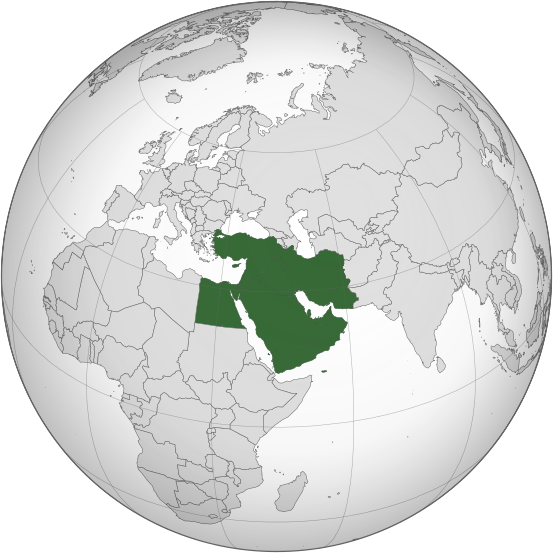
Middle East geopolitics refers to the complex web of political, economic, and military relationships that define the region, a crossroads of civilizations and a critical nexus for global energy and trade. This area, generally encompassing Western Asia and Egypt, has been a theater for imperial ambitions, ideological conflicts, and resource competition for centuries. Its strategic location, bridging Europe, Asia, and Africa, coupled with vast oil reserves, has consistently drawn international attention and intervention. Key dynamics include the Israeli-Palestinian conflict, the rise and fall of regional powers like the Ottoman Empire and Safavid Persia, the impact of ISIS and other non-state actors, and the ongoing rivalry between Iran and Saudi Arabia. Understanding Middle East geopolitics requires grappling with a history marked by colonialism, the Sykes-Picot Agreement, the Cold War's proxy battles, and the post-9/11 era's interventions, all of which continue to shape its volatile present and uncertain future.
🌍 Origins & Historical Currents
The geopolitical landscape of the Middle East is a palimpsest of ancient empires and modern nation-states, each layer profoundly influencing the next. The region's strategic importance was recognized early, with the Persian Empire and later the Roman Empire vying for control. The advent of Islam in the 7th century and the subsequent Islamic Caliphates unified vast swathes, spreading culture and governance. However, the modern borders, largely drawn by European colonial powers like Britain and France following the collapse of the Ottoman Empire after World War I, notably through the Sykes-Picot Agreement, often disregarded ethnic and sectarian realities, sowing seeds of future conflict. The discovery of oil in the early 20th century, particularly in Iran and Saudi Arabia, transformed the region into a global energy powerhouse and a focal point for international competition, setting the stage for the geopolitical dynamics that persist today.
⚙️ The Mechanics of Power
At its core, Middle East geopolitics operates on a complex interplay of state interests, non-state actors, and external influences, often revolving around resource control, ideological competition, and security concerns. The region's vast oil and gas reserves make it indispensable to the global economy, leading major powers like the United States and China to maintain significant strategic interests. Regional rivalries, most notably the ongoing tension between Iran and Saudi Arabia, manifest through proxy conflicts in countries like Yemen and Syria. The presence of powerful non-state actors, such as Hezbollah and Hamas, further complicates the security calculus, challenging state sovereignty and influencing regional stability. The dynamics are further shaped by internal factors like sectarian divides (Sunni-Shia), ethnic aspirations (Kurdish nationalism), and the pursuit of nuclear capabilities, as seen with Iran's nuclear program.
📊 Key Facts & Figures
The Middle East is a region of immense demographic and economic scale, with a combined population exceeding 450 million people. Saudi Arabia consistently ranks among the top global spenders in military spending. The Israeli-Palestinian conflict has persisted for over seven decades, with numerous UN resolutions attempting to broker peace. The region's GDP is substantial, driven by oil exports, but also marked by significant economic disparities between oil-rich nations and others. The military spending in the region is also considerable, with countries like Saudi Arabia consistently ranking among the top global spenders.
👥 Key Actors & Alliances
The geopolitical chessboard of the Middle East is populated by a diverse array of state and non-state actors, each with its own agenda and network of alliances. Key regional powers include Iran, Saudi Arabia, Turkey, and Israel, often finding themselves on opposing sides of various conflicts. Alliances are fluid and often transactional; for example, Israel and several Arab states have normalized relations through the Abraham Accords, a significant shift in regional dynamics. External powers, including the United States, Russia, and China, exert considerable influence through military presence, arms sales, and diplomatic engagement. Non-state actors like Hezbollah in Lebanon and the Houthi movement in Yemen operate with varying degrees of state backing, complicating traditional state-centric geopolitical analysis. Organizations like the Arab League attempt to foster regional cooperation but often struggle with internal divisions.
🕊️ Cultural Resonance & Conflict
The Middle East is not merely a stage for geopolitical maneuvering; it is also a cradle of major world religions and diverse cultures, whose resonance profoundly shapes political identities and conflicts. The historical significance of cities like Jerusalem, Mecca, and Baghdad as centers of religious and intellectual life continues to imbue the region with deep cultural weight. The Sunni-Shia divide, rooted in early Islamic history, remains a potent force, often exploited in contemporary political rivalries, particularly between Iran (predominantly Shia) and Saudi Arabia (predominantly Sunni). The enduring Israeli-Palestinian conflict is not just a territorial dispute but also a deeply emotional and religious issue for many. The rise of political Islam, from the Muslim Brotherhood to ISIS, demonstrates how religious and cultural narratives are mobilized to achieve political ends, influencing everything from domestic governance to international relations.
⚡ Current Flashpoints & Trends
In 2024 and beyond, Middle East geopolitics is characterized by several critical flashpoints and evolving trends. The ongoing war in Gaza following the October 7th attacks has dramatically escalated regional tensions, drawing in Hezbollah and raising fears of a wider conflict. The Iran-Israel rivalry remains a persistent undercurrent, with both nations engaging in shadow wars and proxy actions. Turkey continues to assert its regional influence, balancing relationships with both NATO allies and Russia. The future of Syria and Iraq remains uncertain, with ongoing instability and the lingering threat of extremist groups. Meanwhile, the global energy transition poses long-term questions for oil-dependent economies, prompting diversification efforts in countries like UAE and Qatar. The role of China as an economic and increasingly diplomatic player in the region is also a significant developing trend.
⚖️ Controversies & Debates
The geopolitical dynamics of the Middle East are rife with controversy and debate, challenging simplistic narratives. One major debate centers on the legacy of Western intervention, with critics arguing that actions by powers like the United States and Britain have destabilized the region, while proponents point to efforts to counter extremism and promote stability. The role of Israel and the Israeli-Palestinian conflict remain highly contentious, with ongoing debates about international law, human rights, and the viability of a two-state solution. The influence of Iran's regional policies, particularly its support for proxy groups, is another point of deep contention, with some viewing it as a legitimate defense of national interests and others as destabilizing aggression. Furthermore, the effectiveness and ethical implications of international sanctions, particularly against Iran, are frequently debated, with arguments about their impact on civilian populations versus their utility in curbing nuclear ambitions or regional adventurism.
🔮 Future Trajectories
The future trajectory of Middle East geopolitics is uncertain, but several potential scenarios are emerging. A significant escalation of the Iran-Israel conflict could redraw regional alliances and lead to widespread instability. Conversely, a sustained diplomatic push, potentially brokered by powers like China or the UN, could lead to de-escalation and new regional security frameworks. The long-term impact of the global energy transition on oil-dependent economies remains a critical question, potentially leading to economic diversification or increased internal instability if not ma
Key Facts
- Category
- geopolitics
- Type
- topic